Wisconsin Stamping & Manufacturing’s In-House Automation
Challenge us with your most demanding projects.
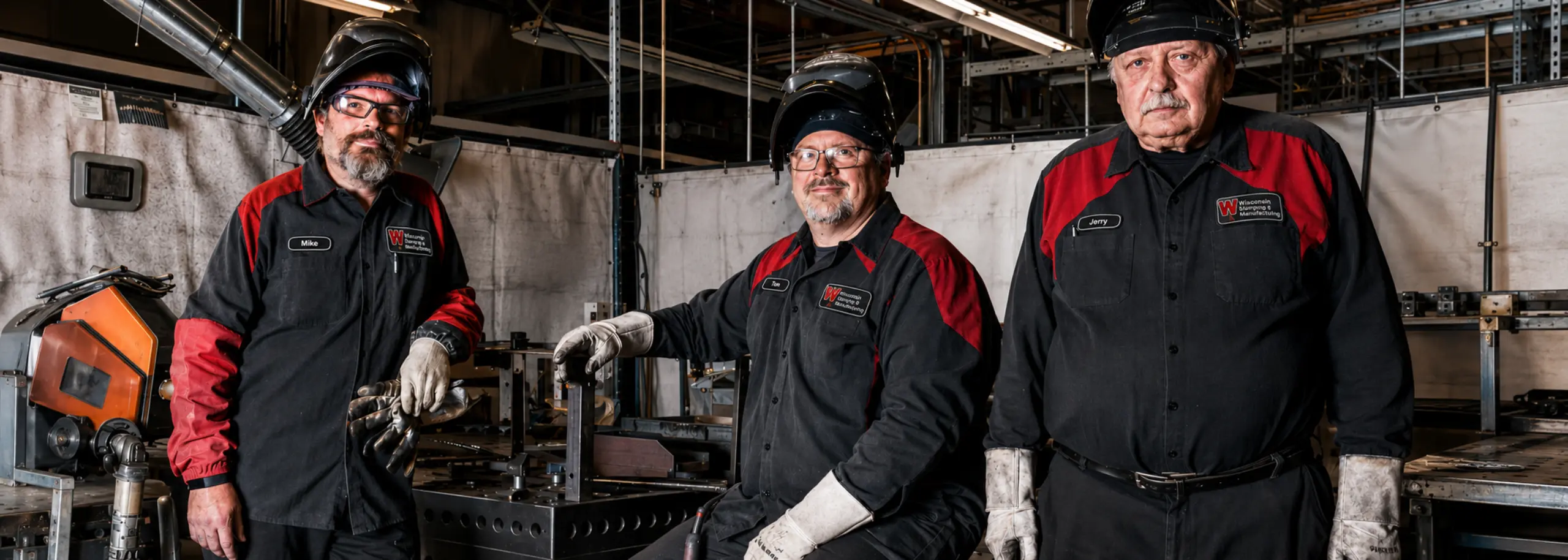
Faster delivery. Better quality. Lower total cost.
Wisconsin Stamping & Manufacturing is an ISO 9001:2015 certified, vertically integrated contract manufacturer offering automated stamping, CNC machining, robotic welding, wire forming, laser cutting, and assembly services. Every automation investment we make is evaluated against one question: Does this make us a more reliable, cost-effective supply partner for OEMs and tier suppliers? This page details how our automated capabilities translate into measurable quality, delivery, and cost advantages for your programs.
Automation Capabilities at a Glance
| Process Area | Automation Type | Key Customer Benefit |
|---|---|---|
| Stamping & Forming | Automated transfer die loading/unloading with cobot-tended part handling; in-process quality sensing | Higher throughput with documented, repeatable quality on every cycle |
| Robotic Welding | Robotic MIG welding cells; fully automated jig/resistance welding | Identical weld paths on every assembly = consistency and quality |
| CNC Machining | Robotic machine tending with optional 100% visual inspection; lights-out Swiss turning with magazine bar loaders | Unattended production around the clock; tolerances held to five decimal places |
| Wire Forming | Fully integrated robotic cells combining CNC forming, machining, welding, and secondary operations in a single setup | Turnkey wireformed components from one cell—compressed lead times, eliminated handling |
| Laser Cutting | Five flat lasers (3kW and 6kW fiber plus CO2) with automated tower systems (up to 30 tons staged material per tower); 8kW fiber tube laser (9″ round / 9×9″ square capacity) | 24/7 lights-out cutting; sheet capacity to 60×120″ |
| Thread Rolling | Robotically tended pick-and-place blank loading | Consistent threads at production speed without manual intervention |
| Finishing | Dedicated robotic cells for edge finishing, deburring, and polishing using automated abrasive belt and buffing systems | Uniform surface quality without operator-dependent variation |
| Inspection & Quality | Inline vision inspection, CMM, programmable MicroVu vision systems, portable articulating measurement arms; climate-controlled ISO 9001:2015 quality lab | Parts inspected from 0.125″ to 60×120″; traceable data for every production run |
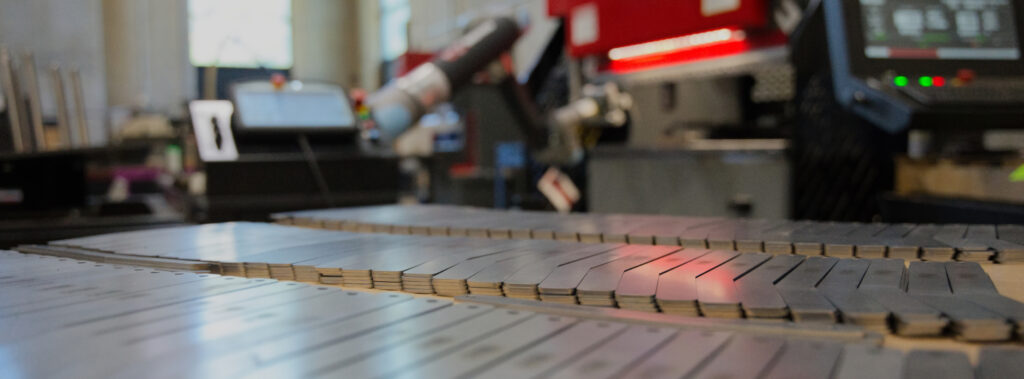
Trust the Numbers That Matter
How Automation Reduces Lead Times and Increases Production Capacity
When demand spikes or a new program launches on a compressed timeline, capacity constraints at your supplier become your problem. Automated processes address this directly through more throughput per shift, more productive hours per day, and faster ramp-up from PPAP approval to production volumes.
Our lights-out capabilities in Swiss machining, laser cutting, and wire forming mean production continues around the clock—without overtime premiums or staffing bottlenecks. Robotic press tending and automated welding cells maintain consistent cycle times shift after shift, eliminating the slowdowns that manual operations experience during ramp-up.
What this means for your programs:
- Faster ramp-up from PPAP approval to full production volumes
- Reliable on-time delivery during demand surges—capacity is not constrained by headcount
- Support for JIT, kanban, and tight release schedules without compromising other customers’ commitments
- Consistent part-to-part uniformity across an entire production run, regardless of lot size or timing
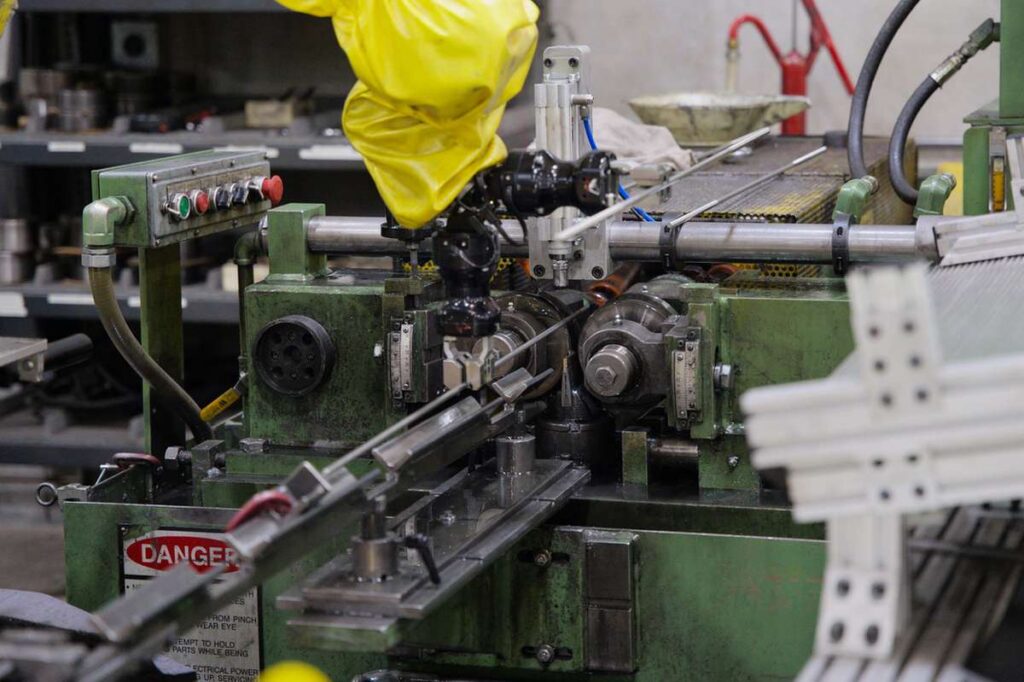
Automated Welding, CNC Machining & Wire Forming Capabilities
Automation at Wisconsin Stamping is not a single showcase cell—it is embedded across the production floor, developed and refined daily by our in-house automation engineering team. In the past 12 months alone, we have commissioned new robotic cells in machining, wire forming, and finishing, with more actively in development.
- Robotic MIG welding cells deliver programmed weld paths on fabricated assemblies with identical consistency on every cycle.
- Fully automated jig/resistance welding handles high-volume assemblies where weld placement and penetration must be repeatable across thousands of parts.
- Automated transfer die loading and unloading with cobot-tended part handling replaces manual press cycling, increasing throughput and reducing operator fatigue-related variation.
- Autonomous robotic press brake operations calculate and execute precise bend angles, maintaining dimensional accuracy across long production runs.
- In-process quality checks and rigorous documentation are maintained throughout every automated stamping and forming line.
- Robotic CNC machine tending with the option for 100% inline visual inspection on exit—implemented where customer requirements or part criticality demand it.
- Full lights-out Swiss machining with magazine-style bar loaders stages multiple bars for continuous unattended production. Tolerances are held to five decimal places (0.00001″) on precision-turned components.
- Advanced CNC turning and multi-spindle lathes run unattended for extended periods, supported by automated loading systems.
- Our newest wire forming cells represent a capability that is well ahead of most contract manufacturers. Each cell integrates a CNC wire former, machining center, welder, and robot—all operating within a single enclosure. Components that previously required separate forming, machining, welding, drilling, piercing, and finishing operations across multiple setups and vendors are now produced in a single cell, single operation, with no human intervention required.
- Few contract manufacturers offer fully integrated wire forming cells with in-cell machining, welding, and robotic tending. This capability eliminates multi-vendor routing, compresses lead times, and delivers part-to-part uniformity that discrete multi-operation processes cannot match.
- Robotically tended thread rolling machines use automated pick-and-place to load blanks, maintaining consistent thread quality at production speed.
- Five flat lasers—including fiber lasers at 3kW and 6kW—with three equipped with automated tower systems. Each tower stages up to 30 tons of material (10 slots × 6,000 lbs per slot) for 24/7 lights-out cutting.
- Dual shuttle tables on CO2 lasers eliminate downtime: one table cuts while an operator unloads and reloads the other.
- 8kW fiber tube laser handles round tube up to 9″ diameter, square tube up to 9×9″, plus aluminum extrusions, L-channel, U-channel, and structural steel. Cutting, drilling, slotting, and profiling happen in a single setup—eliminating secondary machining operations.
- Sheet capacity up to 60×120″. Both flat and tube laser cutting under one roof.
- Dedicated robotic cells for edge finishing, deburring, and polishing use automated abrasive belt and buffing wheel systems with pick-and-place robotic tending. This capability is currently being implemented for production applications.
Every automated cell is backed by:
- In-house tool and die shop—design and build of stamping dies, welding fixtures, work-holding fixtures, and custom checking gauges
- Full CAD/CAM engineering
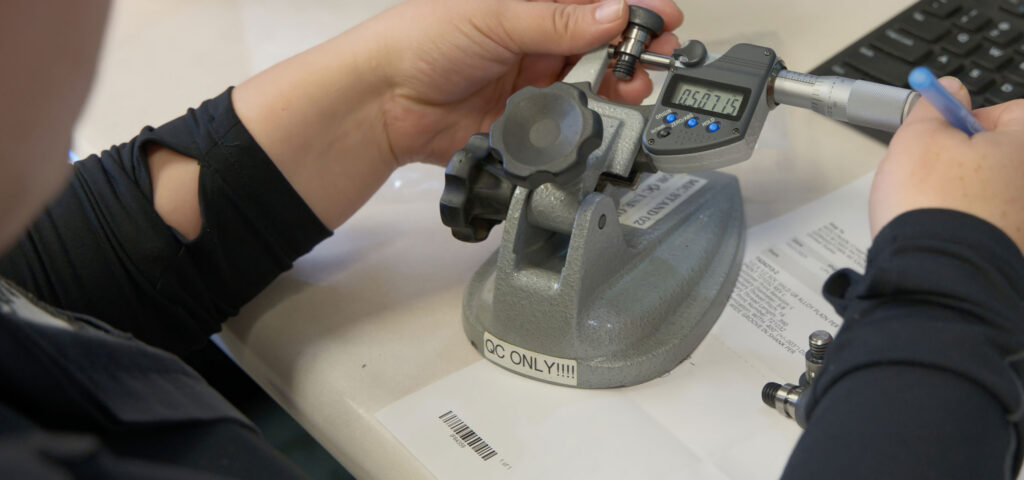
- Climate-controlled ISO 9001:2015 quality lab equipped with CMM, programmable MicroVu vision inspection systems, and portable articulating measurement arms (Hexagon/Romer) for parts from fractions of an inch up to 60×120″
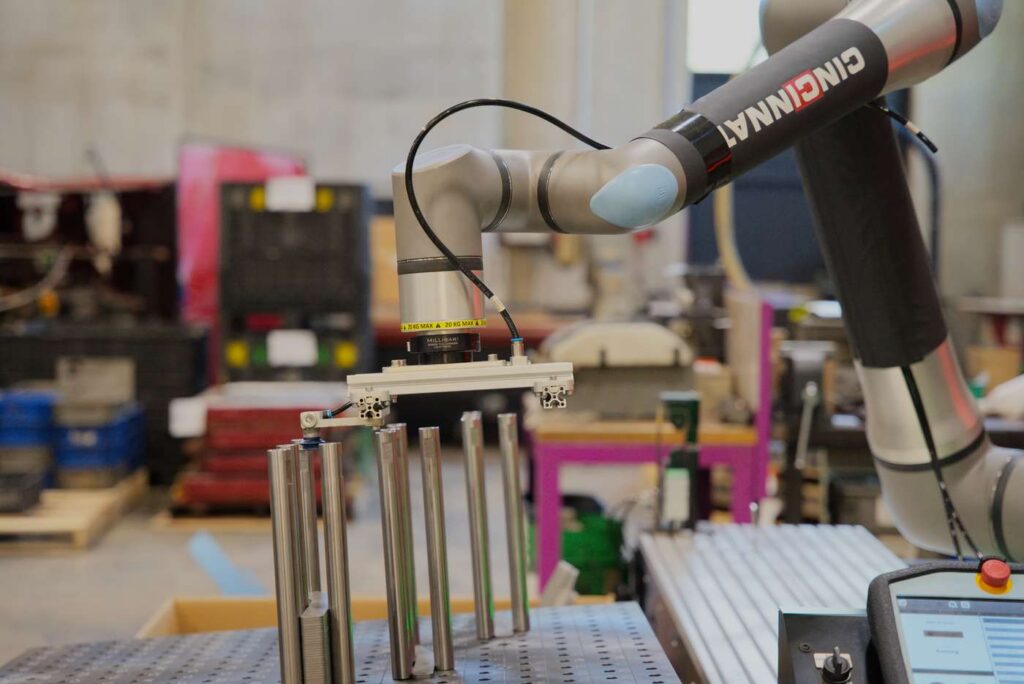
Consistent Quality Through Automated Inspection and Process Control
Inconsistent quality from a supplier does not just create scrap at their facility; it cascades through your receiving inspection, assembly line, and warranty exposure. Automation offers quality outcomes that protect your supply chain:
- Fewer rejects and line disruptions at your receiving dock and assembly stations
- Lower total scrap and rework costs across the entire supply chain—not just at our facility
- Streamlined PPAP and APQP compliance: traceable, data-driven processes generate the documentation your quality team requires without custom requests or delays
- Consistent results from run to run: our climate-controlled quality lab eliminates measurement variation caused by temperature and humidity changes between seasons, so a production run in January measures identically to one in July
Lower Total Cost of Ownership: Automated vs. Manual Supplier Comparison
Piece price matters—but purchasing engineers evaluating total cost of ownership know it is only one variable. The table below illustrates where automation changes the full cost equation and where the hidden costs of a manual-process supplier accumulate.
| Cost Factor | Typical Manual-Process Supplier | Wisconsin Stamping Automated Operations |
|---|---|---|
| Labor content per part | Higher and variable; subject to wage inflation and turnover | Reduced and stable; robotic tending minimizes direct labor dependency |
| Scrap rate | Operator-dependent; increases with fatigue and shift changes | Process-controlled; consistent cycle-to-cycle parameters reduce waste |
| Expedited freight frequency | Higher—quality escapes and missed deliveries trigger emergency shipments | Lower—lights-out capacity and inline inspection catch issues before they ship |
| Incoming inspection burden at your facility | Higher—inconsistent supplier quality requires more frequent checks | Lower—traceable, data-driven processes and custom checking gauges build confidence |
| Tool life and pricing stability | Variable—inconsistent machine cycling accelerates wear | Predictable—consistent automated cycling extends tool life and stabilizes program pricing |
| Corrective action management overhead | Frequent—manual variation generates more nonconformances | Reduced—automated repeatability means fewer CAPAs and less management time |
When you evaluate Wisconsin Stamping against a supplier running primarily manual operations, the piece price may look comparable. The difference shows up in what you don’t spend: expedited freight, incoming inspection labor, rework, sorting costs, and the management overhead of chasing corrective actions.
Looking for Fasteners?
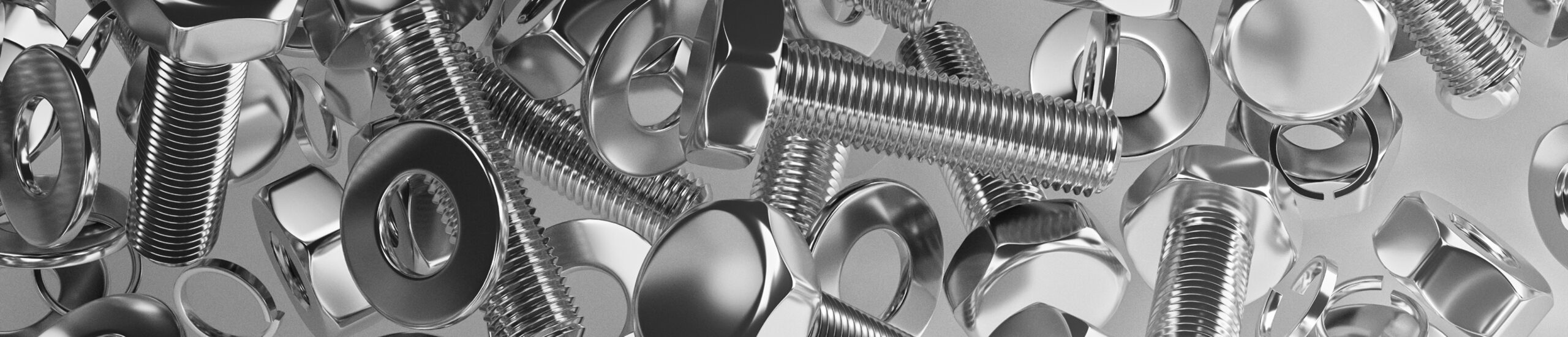
WorldSource Fasteners, a member of the Wisconsin Stamping Family, supplies standard and custom fasteners from hundreds of the world’s leading manufacturers. Get access to the industry’s most trusted names with the optimal fastening solution for your application.

Engineering Support, Tooling Speed, and Production Flexibility
Automation delivers the most value when paired with engineering depth. Our in-house tool and die department designs and builds stamping dies, welding fixtures, work-holding fixtures, and custom checking gauges whichs shortens the development cycle and keeps tooling iterations under one roof.
Programmable equipment across stamping, forming, machining, and welding operations allows efficient transitions between part numbers. This supports both long-run and shorter-run programs without excessive changeover downtime. This is a critical advantage when you need a supplier who handles your full product mix, not just your highest-volume SKUs.
Our engineering team provides collaborative design-for-manufacturability (DFM) input early in the quoting process, including material alternatives, process options, and tolerance optimization. When your design intent is informed by the realities of automated production, the result is a part that runs more efficiently, costs less to produce, and performs more reliably in your end application.
The combination matters: experienced engineers, programmers, and operators direct the automation; not the other way around. Cross-functional teams tackle complex parts, tight tolerances, and demanding applications across every industry we serve. The value comes from people and technology working together, and that problem-solving culture is what turns automated equipment into a genuine competitive advantage for your programs.
Industries Served: Automation Applied Across Demanding Applications
Our automated capabilities serve OEMs and tier suppliers across a range of industries. Each has distinct quality documentation requirements, material specifications, and production volume profiles—and our systems are built to adapt.
| Industry | Typical Components | Relevant Automation Capabilities |
|---|---|---|
| Automotive OEM & Tier Suppliers | Brackets, structural stampings, machined fasteners, welded subassemblies | Automated stamping with in-die sensing; robotic welding; PPAP/APQP documentation from traceable processes; ISO 9001:2015 quality systems aligned to automotive-tier requirements |
| Agricultural Equipment | Heavy-gauge brackets, formed channels, welded frames, wire forms | High-tonnage automated stamping; robotic MIG welding for heavy fabrications; lights-out laser cutting for thick plate |
| Electrical Power Distribution | Precision terminals, bus bars, machined contacts, stamped connectors | Swiss turning to five-decimal-place tolerances; automated stamping with inline vision inspection; climate-controlled inspection lab |
| Light Construction Equipment | Structural brackets, tube-laser-cut components, welded assemblies | Tube laser cutting (structural steel, L-channel, U-channel); robotic welding; kitting and assembly with WorldSource fasteners |
| Powered Hand Tools & Consumer Products | Small stampings, machined shafts, formed wire components, assembled kits | Integrated wire forming cells; automated thread rolling; assembly and blind-ship fulfillment |
| HVAC & Appliance Manufacturing | Sheet metal brackets, formed components, fastener-inserted panels | Automated PEM® insertion; robotic press brake forming; automated edge finishing and deburring |
Your Automation Questions Addressed
Wisconsin Stamping & Manufacturing – Your idea. Our ingenuity. A perfect match.
Automation impacts the metrics you are measured on: total cost, PPM quality, on-time delivery, and supplier risk. Automated processes deliver more consistent parts with lower scrap rates. Lights-out manufacturing supports tighter delivery schedules. Vertical integration reduces total cost of ownership by minimizing rejects, rework, and the overhead of managing multiple suppliers.
In most cases, automation reduces total part cost. Lower labor content, reduced scrap, fewer secondary operations, and higher throughput all contribute to competitive pricing. Automation also reduces hidden costs — rejects, line disruptions, expedited freight, warranty exposure — that often exceed any piece-price savings from a lower-cost manual supplier.
Wisconsin Stamping is ISO 9001:2015 certified and has maintained certification for over two decades. We provide PPAP at Levels 1–5: first article inspection, control plans, PFMEA, SPC data, measurement system analysis, and Certificates of Conformance. We support IMDS reporting and comply with RoHS and REACH requirements. Documentation is customized to your program — no unnecessary overhead, no corners cut.
Yes. Programmable CNC equipment and flexible robotic cells support rapid transitions between part numbers. Short-run and prototype production runs on the same equipment that ramps into high-volume production with lights-out capability. One supplier from prototype through production eliminates the quality variation that supplier transitions introduce.
Our automation investments provide scalable capacity not constrained by staffed shifts. Lights-out Swiss machining, 24/7 laser cutting with 30-ton tower systems, robotic welding, and unattended CNC machining extend production hours well beyond a standard operating day. We support JIT, kanban, and tight release schedules as standard practice.
When you source stamped parts from one vendor, laser-cut parts from another, machined components from a third, and welding from a fourth, you manage four quality systems and four delivery schedules. Consolidating means one ISO 9001:2015 quality system, one delivery commitment, one point of accountability, and built-in redundancy across 170,000+ square feet of production capacity.
Client Stories
After six decades as a diversified manufacturer, Wisconsin Stamping & Manufacturing has worked with some of the world’s most successful and innovative companies.